Pay Your Neighbor to Buy: The 1880s Patent Medicine Machine That Invented Growth Hacking
Photo: unknown, Public domain, via Wikimedia Commons
In 2008, Dropbox introduced a referral program that gave users extra storage for every friend they recruited. The company's growth rate doubled almost immediately. Drew Houston called it one of the most important product decisions the company ever made, and the technology press treated it as a stroke of modern genius.
It was not modern. It was not even close.
The Salesman Who Already Knew Your Name
By the early 1880s, the American patent medicine industry had developed a customer acquisition model so structurally sophisticated that its core mechanics would be instantly recognizable to any growth engineer working today. Companies like the Kickapoo Indian Medicine Company, Dr. Pierce's Invalids' Hotel, and Lydia Pinkham's Vegetable Compound were not simply selling product door to door. They were building self-replicating distribution networks, and the fuel running those networks was the social credibility of people who already believed.
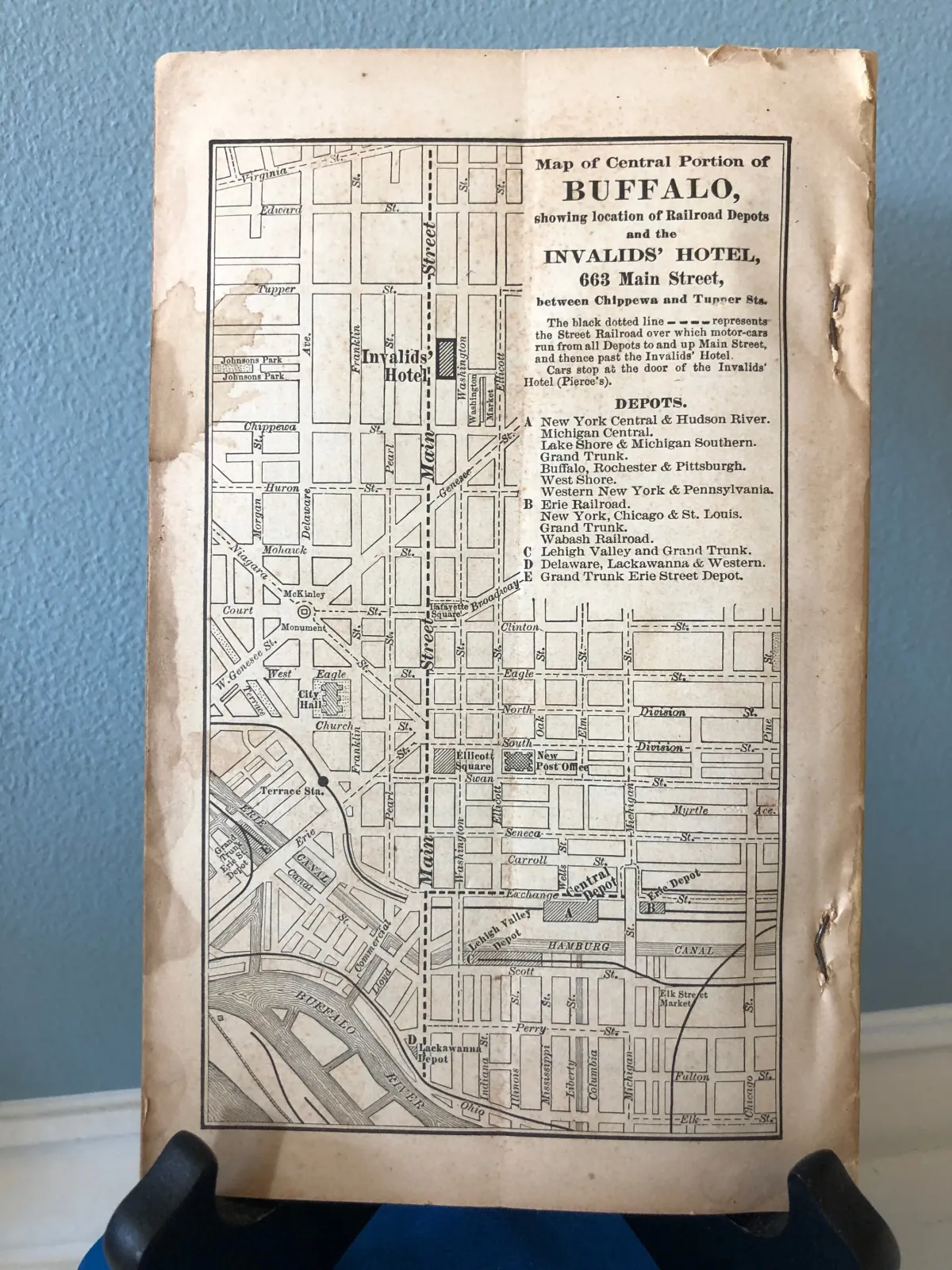 Photo: Dr. Pierce's Invalids' Hotel, via i.etsystatic.com
The mechanism worked like this. A traveling agent — the 19th-century equivalent of a field sales representative — would enter a town and identify what the trade called a 'local friend.' This was typically a respected community member: a farmer's wife with wide social ties, a deacon, a retired schoolteacher. The local friend received product at no cost or at a steep discount. In exchange, they were asked to recommend the tonic to their neighbors and to collect the names of anyone who expressed interest.
Those names went into a ledger. The local friend received a commission — sometimes cash, sometimes more product, sometimes a printed certificate of endorsement that functioned as a status marker within the community — for every paying customer that name-list produced. The salesman moved on. The local friend kept selling.
This was not informal gossip. It was an engineered referral loop with tracking, tiered incentives, and a deliberate exploitation of social proof.
Tracking Before the Pixel
Modern referral programs live or die by attribution. You need to know which referrer produced which customer, or the incentive structure collapses. This problem is often framed as a technical one — a matter of cookies, UTM parameters, and database architecture. Patent medicine companies solved the same problem with paper.
Many companies issued coded order forms. When a customer placed an order through a local friend's referral, the form included a handwritten or pre-printed identifier tied to that specific recruiter. The company's back-office clerks — and these were substantial back offices; Lydia Pinkham's operation employed dozens of people handling correspondence alone — used those codes to calculate commissions and track which local friends were performing.
High performers received upgraded status. Some companies printed tiered agent classifications in their internal circulars: a basic local friend became a district agent, a district agent became a county manager. Each tier came with better margins and more prominent mention in company literature. The psychological architecture was identical to what modern platforms call a 'power user program.'
The lesson the patent medicine companies had absorbed, and that Silicon Valley would rediscover roughly a century later, was straightforward: the cheapest customer you will ever acquire is the one delivered to you by someone who already trusts your product. The second cheapest is the one delivered by someone who is being paid to say they trust it.
The Testimonial as Growth Engine
No discussion of patent medicine referral mechanics is complete without addressing the testimonial, because the testimonial was not merely advertising — it was a referral token.
Companies actively solicited written endorsements from customers and then reprinted those endorsements in almanacs, circulars, and newspaper advertisements. But the more sophisticated operators went further. They paid customers — again, in product, in cash, or in the currency of public recognition — to share their testimonials directly with neighbors. The customer became an active recruiter, not merely a satisfied buyer.
The social proof function here was doing double work. The testimonial validated the product for skeptical prospects. But the act of being published, of seeing one's name in print as an endorser, also deepened the original customer's commitment. Psychologists today would call this consistency bias: once you have publicly declared a belief, the cognitive cost of abandoning it rises sharply. Patent medicine companies did not have the vocabulary of behavioral economics, but they had the results.
Lydia Pinkham's company maintained what amounted to a correspondence department whose sole purpose was managing this relationship — answering letters from customers, encouraging them to share their experiences, and identifying which correspondents had the social reach to function as effective local amplifiers.
The Uncomfortable Continuity
The parallel to Dropbox, Uber's early rider referral credits, or PayPal's famous cash-for-signup program is not superficial. The underlying logic is identical because the underlying psychology is identical. Human beings extend trust to their social networks before they extend it to strangers. Human beings respond to status gradients. Human beings who have publicly committed to a product are more likely to recruit for it than those who have not.
None of these facts were discovered by a growth team in 2010. They were road-tested on rural Iowa in 1883, by men carrying suitcases full of Kickapoo Indian Sagwa and a very clear understanding of how small towns work.
What changed between then and now is the speed of the loop and the precision of the tracking. The psychology did not change at all. History's laboratory ran the experiment first, and the results have been consistent across every iteration since.
The next time a technology company announces that it has 'cracked' word-of-mouth growth, it is worth remembering that the crack was already there, and someone else found it long ago.