Turning Customers Into Salespeople: The Patent Medicine Industry's Growth Machine
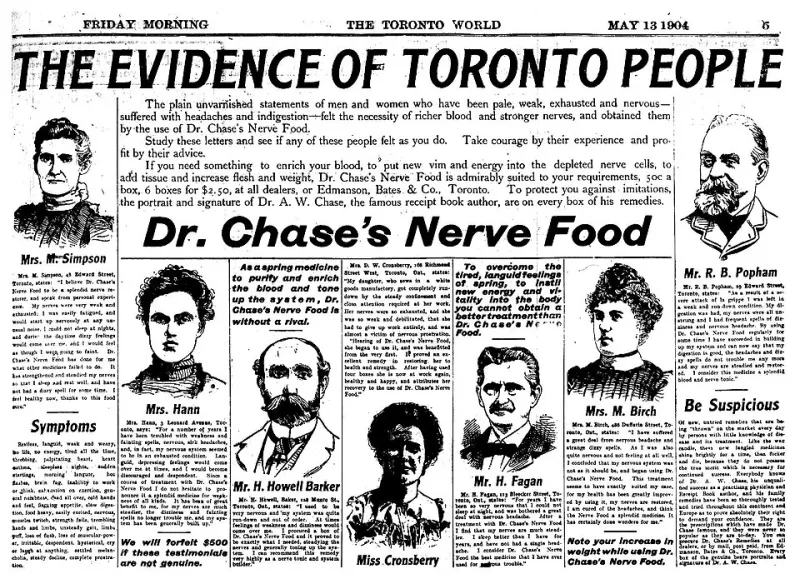
Photo: Dr. Chase's Nerve Food, Public domain, via Wikimedia Commons
Turning Customers Into Salespeople: The Patent Medicine Industry's Growth Machine
Somewhere in a venture capital pitch deck being assembled right now, a founder is explaining a 'viral loop.' The logic goes something like this: a satisfied user tells a friend, the friend becomes a user, that user tells another friend, and the cycle compounds until the company either dominates its market or runs out of runway. It is presented as a product of the digital age — a clever exploitation of network effects that only became possible once everyone carried a connected device in their pocket.
It is, in fact, a product of the 1870s.
Long before growth hackers had a name for what they were doing, the patent medicine industry had already built the machinery. And they built it not because they were especially clever, but because they were paying close attention to something that has never changed: the way human beings decide whom to trust.
The Architecture of Early Referral Marketing
Lydia E. Pinkham's Vegetable Compound, introduced in 1875 and marketed as a remedy for 'female complaints,' became one of the most successful consumer products of the nineteenth century. Its dominance was not accidental. Pinkham's company — run largely by her sons after her death in 1883 — built what can only be described as a customer acquisition machine, and its primary fuel was social proof.
The company solicited testimonial letters from customers and published them aggressively in newspapers, almanacs, and pamphlets. But the more sophisticated mechanism was what happened after the testimonial was submitted. Customers who wrote in received responses, sometimes personalized advice, and were encouraged to share the product with women in their social circles. The company understood, with a clarity that would impress a modern behavioral economist, that a recommendation from a neighbor carries more persuasive weight than any advertisement a stranger could place.
This is not a trivial observation. It reflects a durable feature of human cognition: we calibrate trust through social proximity. We are more persuaded by people who share our circumstances than by those who do not. The patent medicine companies did not discover this principle. They simply operationalized it at scale, which is precisely what Dropbox did when it offered extra storage for referrals in 2008, and what Uber did when it gave both rider and driver a credit for each successful introduction.
The Testimonial as Social Currency
What made the patent medicine referral apparatus so effective was not the financial incentive — though those existed — but the social one. Submitting a testimonial and having it published transformed a customer into a public advocate. It gave the act of purchasing a product a secondary identity: you were not merely a consumer; you were a satisfied authority whose experience was worth broadcasting.
This dynamic maps almost perfectly onto what behavioral economists call 'identity-based motivation.' When a behavior becomes part of how a person sees themselves — as someone whose opinion matters, whose recommendations are sought — they are far more likely to continue performing that behavior. The patent medicine companies were not just selling tonics. They were selling membership in a community of informed, experienced women who helped one another navigate their health.
Modern referral programs do the same thing with different vocabulary. When a company asks you to 'invite a friend,' it is not merely requesting a mechanical action. It is offering you the role of benefactor — someone who improves the lives of the people around them. The framing is social before it is transactional.
Manufactured Scarcity and the Almanac Network
The distribution network the patent medicine industry constructed was itself a marvel of nineteenth-century logistics. Companies printed millions of almanacs — free, useful, and saturated with advertising — and distributed them through druggists, general stores, and mail order. Each almanac was a referral node: it arrived in a household, was passed between neighbors, and carried testimonials from women in similar communities across the country.
The almanac served the same structural function as a referral link. It was a trackable (or at least traceable) artifact that moved through social networks, carrying both the product's message and the implicit endorsement of whoever passed it along. The druggist who stocked it was a trusted intermediary. The neighbor who lent her copy was an unwitting affiliate.
Today's referral programs replace almanacs with unique URLs and replace druggists with app store algorithms. The underlying graph — trusted person to trusted person, product message traveling along existing social bonds — is identical.
Why the Loop Still Works
The reason patent medicine referral mechanics translate so cleanly into modern growth strategy is not that nineteenth-century marketers were unusually prescient. It is that they were working with the same human material that every marketer since has worked with. Social trust has not been patched or updated. The cognitive shortcuts that made a neighbor's recommendation persuasive in 1880 make an influencer's sponsored post persuasive today, for precisely the same neurological reasons.
Human beings are social animals who evolved to navigate uncertainty by watching what the people around them do. When we cannot fully evaluate a product, a service, or a claim on our own, we look to others who appear to have already done the evaluation for us. Patent medicine companies understood this before psychology had a technical vocabulary for it. They knew that a letter from a woman in Ohio describing her relief from suffering would sell more bottles than any amount of clinical-sounding copy, because the letter activated a social circuit that clinical copy could not reach.
Silicon Valley did not invent the viral loop. It automated it. The distinction matters, because automation can be redesigned. The underlying psychology cannot.
What the Historical Record Tells Growth Marketers
There is a habit in the technology industry of treating every effective tactic as a discovery — something that emerged from data and experimentation and belongs to the current moment. The patent medicine industry's referral architecture suggests a different interpretation: that effective tactics endure precisely because they are not discoveries at all, but rather rediscoveries of constants.
If you want to understand why a referral program works, you do not need an A/B test. You need to understand why human beings have always trusted their neighbors more than strangers, why being asked for a recommendation feels like a social reward rather than a burden, and why public advocacy deepens private commitment. History provides all three answers, in abundant detail, across populations and centuries.
The patent medicine companies were not ethical paragons. Many of their products were useless, and some were harmful. But their understanding of the social mechanics of trust and recommendation was precise, durable, and — stripped of the snake oil — completely transferable. The hoodie is new. The playbook is not.