Pass the Hat: The 19th-Century Performer's Dilemma That Patreon Has Never Actually Solved
Photo: The Library of Congress, No restrictions, via Wikimedia Commons
Pass the Hat: The 19th-Century Performer's Dilemma That Patreon Has Never Actually Solved
There is a moment, familiar to anyone who has attended a street performance, a small-venue folk concert, or a church basement lecture, when the performer's posture changes. The work is finished. The audience, which was recently transported, is now returning to itself — gathering coats, checking the time, preparing to leave. And then the performer, or someone acting on their behalf, introduces the question of money.
The air in the room changes. It has always changed. It changed in the same way in an 1870s Ohio town hall when a traveling lecturer concluded his remarks and gestured toward the collection basket near the door. The psychological mechanism at work in that moment is not a product of any particular technology or cultural moment. It is a feature of human social cognition that has remained essentially unchanged across the entire span of recorded commercial entertainment.
Understanding why that moment is so uncomfortable — and why it has proven so resistant to design solutions across two centuries — requires taking the historical record seriously as a psychology laboratory.
The Itinerant Economy and Its Fundamental Problem
Before the institutional infrastructure of American entertainment — the theater chains, the record labels, the ticketing monopolies — there was a vast, loosely organized network of performers who moved through the country's towns and cities, exchanging their labor for whatever the audience would voluntarily provide.
The Chautauqua circuit, which carried lecturers, musicians, and performers to rural communities from roughly the 1870s through the 1920s, was the most organized expression of this economy, but it represented only its upper tier. Below the Chautauqua speakers — who had contracts, guaranteed fees, and institutional backing — was an enormous population of performers who operated on pure voluntary exchange. Traveling fiddlers. Itinerant preachers who passed the plate. Medicine show musicians who played for crowds that had come to buy dubious tonics. Street magicians in every city with a commercial district.
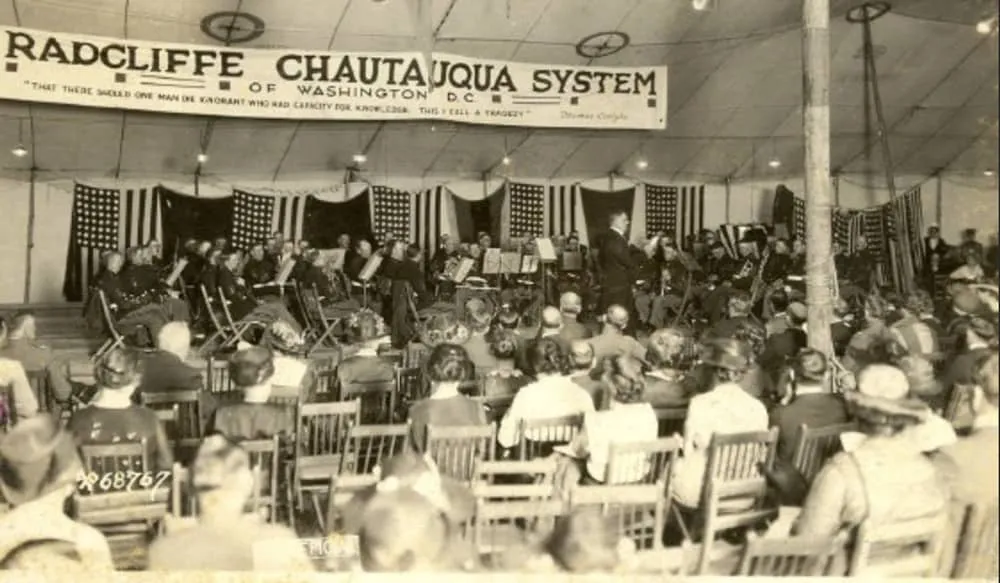 Photo: Chautauqua circuit, via www.chq.org
All of these performers confronted the same structural problem: the audience had already received the value before the payment was requested. Unlike a merchant selling a physical good, the performer could not withhold delivery pending payment. The experience was the product, and the experience was already over.
This is not a minor logistical detail. It is the central psychological challenge of every creator economy that has ever existed, and it has not been solved by any platform, payment system, or social norm in the intervening 150 years.
The Social Technology of the Collection
Performers in the 19th century developed an elaborate set of techniques for managing the collection moment — techniques that, examined carefully, reveal a sophisticated intuitive understanding of social psychology.
The most important of these was the construction of community obligation. A skilled performer, before passing the hat, would explicitly frame the audience as a group — not a collection of individuals each making a private economic decision, but a community whose collective generosity would determine whether this kind of event could continue. "If you've enjoyed the evening, and I believe you have, then the folks in the next county deserve the same chance" was a rough template for dozens of variations on this appeal.
This framing was not manipulative in a cynical sense. It was an accurate description of the economics. But its psychological function was to shift the act of paying from a private transaction — one individual deciding whether a product was worth a price — to a public act of community membership. Giving became a signal of belonging. Not giving became a signal of defection.
This is, with only modest translation, the emotional architecture of every Patreon appeal, every Substack upgrade prompt, and every public radio pledge drive. "Support this work so it can continue" is the Chautauqua collection basket in a digital interface. The social obligation mechanism is identical. The awkwardness is identical.
Why the Awkwardness Is Structural, Not Accidental
The discomfort of the voluntary payment moment is not a design failure. It is a direct consequence of the value sequence: experience first, payment second.
Human beings are exquisitely sensitive to the social dynamics of reciprocity. Anthropological research across cultures consistently shows that gift exchange — which is what voluntary payment for creative work functionally resembles — generates anxiety precisely because the terms are unspecified. A purchase has a price. A gift has an obligation whose magnitude is determined by social norms that are rarely explicit and frequently contested.
When an audience member watches a street performer and then decides whether to put money in the case, they are navigating a genuine social negotiation. How much did I enjoy this? How much do I think others are giving? What will this person think of me if I give less than that? What will the people around me think? Is this a professional whose livelihood depends on this, or a hobbyist who would do it anyway?
None of these questions have clean answers. The cognitive load of resolving them, in the moment, in public, is the source of the discomfort. And the discomfort produces a well-documented behavioral response: avoidance. People leave before the hat comes around. They find reasons to look elsewhere. They give a small amount quickly to terminate the social negotiation rather than a considered amount arrived at through reflection.
The Chautauqua performers knew this. They developed techniques specifically to prevent the audience from physically leaving before the collection — lingering encores, strategic positioning of the basket near the only exit, the deliberate prolonging of the social warmth of the performance into the payment moment. Contemporary creator platforms use the equivalent: the payment prompt embedded in the content stream rather than appended at the end, the "pay what you want" slider that anchors on a suggested amount, the social proof display showing how many other people have already subscribed.
The Patron Relationship and Its Discontents
There was a tier above the hat-passing performers in the 19th-century itinerant economy: those who had secured patronage. A lecturer with a wealthy sponsor, a musician retained by a prominent family, a writer whose work was underwritten by a publisher willing to absorb losses in exchange for prestige — these creators had escaped the collection moment by resolving the payment question in advance.
But the patron relationship introduced its own psychological distortions. The performer who depended on a specific patron's continued goodwill faced a different version of the same problem: how to maintain the authenticity of the work while remaining legible to the person whose financial support made the work possible. This is the tension that every Patreon creator navigates when a significant donor requests content in a particular direction. It is the tension every Substack writer feels when subscriber growth stalls and the temptation to write for the existing audience rather than the potential one becomes acute.
The 19th-century solution to this tension was largely the same as the contemporary one: maintain the fiction that the patron relationship does not influence the work, while quietly allowing it to influence the work in ways that can be rationalized as aesthetic rather than commercial decisions. This is not hypocrisy. It is the normal human response to a structural conflict between economic dependence and creative autonomy.
The Transaction That Cannot Be Made Comfortable
Two centuries of experimentation have not produced a version of the voluntary creative payment that feels natural. This is not because the designers have been insufficiently clever. It is because the awkwardness is not a user experience problem. It is a social cognition problem, and social cognition has not been updated since the last time the relevant neural architecture was revised, which was considerably before the first Chautauqua tent went up.
The hat will keep being passed. The audience will keep feeling the specific discomfort of being asked to assign a price to something that has already moved them. The platforms will keep iterating on the interface, convinced that the friction is a design problem one more A/B test away from resolution.
The historical record suggests otherwise. The awkwardness is the transaction. It always has been.