Ancient Oracles, Modern Gurus: The Unchanged Psychology of Paying for Prophecy
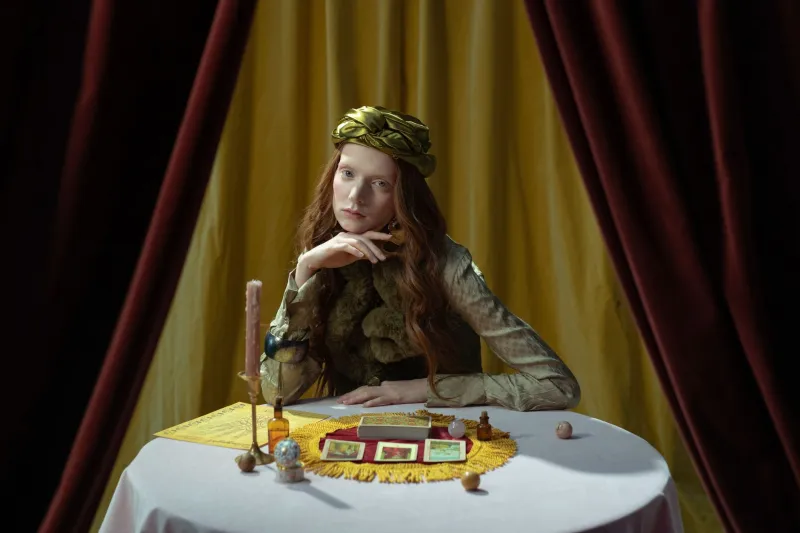
The Business of Believing
Sometime around the fourteenth century, a traveling astrologer arrived in a European market town with charts, instruments, and a practiced air of authority. He had never met a single person in that town. Within two days, he had collected fees from dozens of them—each convinced he had perceived something uniquely true about their circumstances, their futures, their hidden selves. He had not. He had deployed a toolkit refined across generations, and it worked with near-mechanical reliability.
Seven hundred years later, a wellness influencer posts a morning routine video. She has never met her 2.3 million followers. Within forty-eight hours, her supplement affiliate links have generated six figures in commissions. Each buyer is convinced the product was selected with their particular needs in mind. It was not. The toolkit is identical.
History does not repeat its headlines. But it does repeat its psychological mechanisms with unnerving fidelity. The gap between a medieval astrologer and a modern wellness guru is not a gap in method—it is a gap in costume.
The Architecture of Vagueness
The foundational technique of every fortune teller who ever operated a booth at a Renaissance fair—or its historical equivalent—was what researchers now call the Barnum effect: the delivery of statements so carefully imprecise that nearly any listener recognizes them as personally true. "You have experienced a period of self-doubt that others do not fully appreciate." "There is a relationship in your life that requires more attention than you have given it." "You possess capabilities that have not yet found their proper expression."
These are not observations. They are mirrors held at a flattering angle.
Medieval astrologers and court diviners understood this intuitively. Their astrological charts were elaborate props—convincing enough to signal expertise, complex enough to discourage scrutiny, and interpreted with sufficient flexibility that the reading could be adjusted in real time based on the client's reactions. A slight nod, a catch of breath, a shift in posture—these were data points that shaped the narrative as it unfolded.
Contemporary life coaches do not read star charts. They administer personality assessments, enneagram tests, and proprietary frameworks with names like "The Alignment Matrix" or "The Clarity Code." The function is identical: generate a personalized-seeming profile that flatters the subject's self-conception, then sell them a program designed to help them become more fully themselves. The assessment is the prop. The reaction-reading is the skill.
The Hidden Knowledge Premium
One of the most durable revenue models in the history of human persuasion is the promise of esoteric access. Medieval practitioners of alchemy, astrology, and occult medicine did not merely sell predictions—they sold membership in a community of the initiated. Their knowledge was framed as ancient, suppressed, and unavailable to ordinary people. To receive it was to be elevated.
The premium was not for information. It was for the feeling of being chosen.
This structure maps onto modern wellness culture with uncomfortable precision. The wellness guru does not sell you a diet—she sells you a "protocol" derived from "research most doctors won't tell you about." The life coach does not offer advice—he offers "proprietary methodology" developed through "years of private client work." The supplement brand does not market vitamins—it markets "bioavailable formulations" based on "cutting-edge nutritional science" inaccessible to mainstream medicine.
The framing of suppression is particularly significant. Medieval alchemists claimed their knowledge was hidden by the Church or by jealous rivals. Modern wellness practitioners claim their knowledge is suppressed by pharmaceutical companies, the medical establishment, or regulatory capture. The claim does not need to be true. It needs only to position the guru as a courageous truth-teller and the customer as a discerning insider. Both roles are deeply flattering, and flattery has always been the most efficient path to a sale.
Personalization as Illusion
When a fifteenth-century healer prepared a remedy for a specific patient, the ritual of personalization was itself the therapy. The healer would examine the patient at length, ask probing questions, consider the patient's constitution, their planetary alignment, their humoral balance. The remedy that emerged from this process was, chemically, often identical to what any other patient received. But it had been visibly tailored. The patient had been seen.
The desire to be seen—genuinely, specifically, individually seen—is among the most consistent features of human psychology across recorded history. It does not diminish with education or sophistication. It may intensify under conditions of social isolation and mass anonymity, which is a reasonable description of American life in the twenty-first century.
Wellness platforms have industrialized the illusion of personalization at a scale medieval healers could not have imagined. Algorithmic quizzes generate "customized" supplement regimens. AI chatbots offer "personalized" coaching conversations. Subscription boxes deliver "curated" wellness products selected by a system that has processed your responses to fourteen questions. None of this is genuinely individual. All of it feels that way, which is the only standard that has ever mattered commercially.
The Loyalty Loop
The most sophisticated medieval practitioners understood something that took marketing science centuries to formalize: the initial sale is not the product. The relationship is the product.
Fortune tellers who built lasting practices—as opposed to traveling grifters who moved before the complaints accumulated—created dependency through a specific mechanism. They provided just enough accurate-seeming insight to establish credibility, then introduced just enough uncertainty to require follow-up consultations. The future was always partially revealed, never fully resolved. The next reading would clarify what this one had suggested.
This is a subscription model. It was operating in medieval marketplaces centuries before anyone used that term.
Modern wellness culture has reproduced this structure with remarkable fidelity. The coaching program ends with an upsell to a "deeper dive" mastermind. The supplement protocol requires monthly refills to "maintain results." The app's free tier reveals enough to demonstrate value while withholding enough to justify the premium subscription. The guru's book contains the framework; the course contains the application; the private community contains the guru herself. Each layer of access is priced above the last.
What the Record Shows
The history of fortune telling, faith healing, and occult medicine is not primarily a history of fraud, though fraud was certainly present. It is a history of genuine human need—for certainty in uncertain times, for personalized attention in impersonal societies, for the feeling that hidden forces are knowable and manageable—meeting practitioners skilled at addressing that need in ways that felt real, regardless of whether they were.
The psychological needs that sustained medieval astrologers have not changed. The anxiety about the future, the hunger for self-understanding, the desire to belong to a community of the enlightened—these are not pathologies of a credulous past. They are features of human cognition that have survived every advance in education, science, and material comfort.
The wellness industry did not invent a new kind of customer. It found an old one and gave them a new vocabulary. The oracle is still in business. The address has changed.