Caesar Had an Algorithm: How Rome's Greatest Politician Mastered the Information War
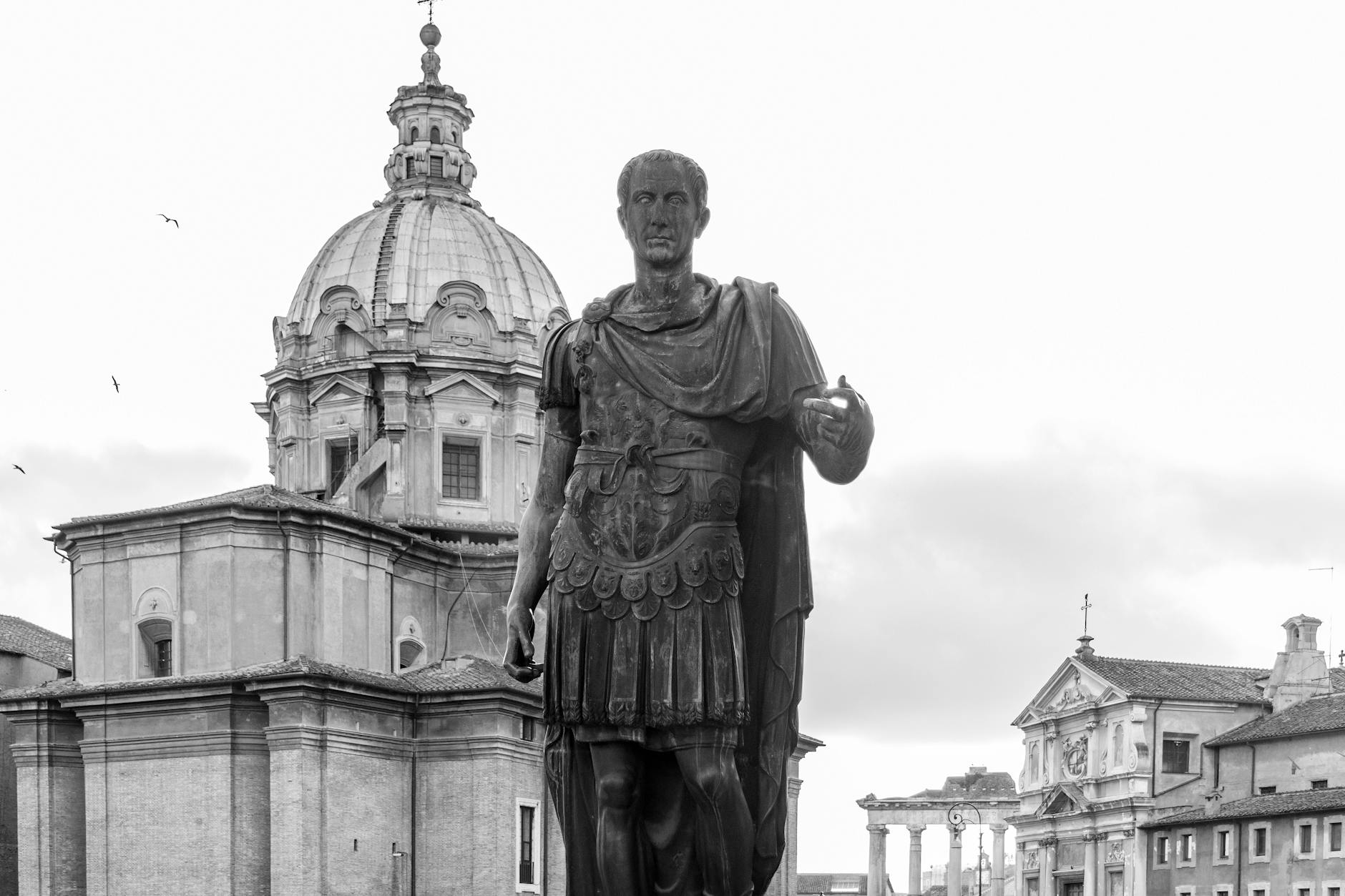
Caesar Had an Algorithm: How Rome's Greatest Politician Mastered the Information War
Julius Caesar never sent a tweet, but he understood the mechanics of viral persuasion with a sophistication that would make a modern political consultant blush. Two thousand years before social media platforms began optimizing for engagement, Caesar was engineering consent at scale — and the psychological levers he pulled are the same ones being pulled on you right now.
History is not a museum of quaint mistakes. It is the largest psychology laboratory ever assembled, stocked with billions of human subjects across thousands of years of uncontrolled experiments. If you want to understand how misinformation spreads in 2024, you could read a study conducted on 200 undergraduates in a university basement, or you could examine how one Roman general dismantled a republic by mastering the information environment of his age. The data set is considerably richer in the second case.
The Coin as the Original Sponsored Post
Rome had no printing press, no broadcast network, and no fiber-optic infrastructure. What it had was coinage — and Caesar understood that every denarius in circulation was a piece of content delivered directly into the hands of the Roman public.
In 44 BCE, Caesar did something that had no precedent in Roman tradition: he had his own living portrait stamped onto the currency. Previous coins depicted gods, ancestral heroes, or allegorical figures. Caesar put himself there — laurel-wreathed, sharp-featured, unmistakable. The message was not subtle. It associated him visually with divine authority and permanent power at a moment when he was consolidating exactly that.
Consider the distribution mechanism. Coins changed hands in every market transaction, every tax payment, every soldier's wage. There was no opting out of the feed. Every Roman who bought bread or paid a debt received the same image, reinforced repeatedly, embedded in the most trusted object in daily economic life. Modern researchers call this the mere exposure effect — the well-documented psychological phenomenon whereby repeated exposure to a stimulus increases positive affect toward it, independent of any rational evaluation. Caesar didn't know that term. He understood the principle completely.
This is not meaningfully different from a political figure purchasing saturating ad inventory across every platform a voter uses. The technology is unrecognizable. The cognitive exploit is identical.
Monuments, Spectacle, and the Architecture of Belief
Coins were Caesar's ambient content strategy. His building program was his flagship campaign.
The Forum of Caesar, the Temple of Venus Genetrix, the elaborate public games he sponsored — these were not merely civic improvements. They were argument made physical. The Temple of Venus was particularly pointed: by claiming Venus as his divine ancestor, Caesar was embedding his personal mythology into the sacred geography of the city itself. You could not walk through Rome without encountering evidence that Caesar was touched by the gods.
The psychological mechanism here is what behavioral economists now call environmental priming — the way physical surroundings shape cognition before conscious reasoning even engages. When your beliefs are literally carved into the marble of every public space, skepticism requires active effort. Acceptance is the path of least resistance. This is why authoritarian regimes across history have invested so heavily in architecture, statuary, and the visual colonization of public space. And it is why modern platforms invest so heavily in interface design that makes sharing frictionless and critical evaluation effortful.
The medium changes. The manipulation does not.
The Commentarii and the Art of Narrative Control
Caesar's most sophisticated propaganda instrument was also his most literary. His Commentarii de Bello Gallico — the campaign dispatches he sent back to Rome during the Gallic Wars — were written in the third person, in a spare, seemingly objective style that projected the authority of neutral reportage while delivering a carefully curated account of events in which Caesar was perpetually decisive, just, and victorious.
He wrote about himself as though he were someone else observing a great man. The rhetorical effect was considerable. First-person boasting invites skepticism. Third-person narration implies documentation. The Commentarii were read aloud in public forums, circulated among the educated class, and shaped the Roman understanding of a war that most Romans would never see. Caesar controlled the only feed.
This is, functionally, the logic of the anonymous source, the leaked memo, and the strategic third-party validator — tactics as current as this morning's news cycle. When a political operation plants a favorable story with a sympathetic outlet rather than issuing a direct statement, it is executing the same epistemological judo Caesar performed in his dispatches. The appearance of independent verification is the most powerful persuasion tool available, because it bypasses the audience's natural defenses against obvious advocacy.
What the Algorithm Actually Is
The contemporary conversation about algorithmic misinformation tends to locate the problem in the technology — in recommendation engines, in engagement optimization, in the specific architecture of platforms built in Silicon Valley over the last two decades. This framing is not wrong, but it is incomplete in a way that matters.
The algorithm is not the vulnerability. The algorithm is a delivery mechanism for content that exploits vulnerabilities that are much older and much harder to patch. Those vulnerabilities are neurological. They include the mere exposure effect, in-group/out-group cognition, the authority bias, the narrative transportation effect — the suite of cognitive tendencies that made Caesar's propaganda effective in 44 BCE and makes its digital descendants effective today.
The Roman information environment had no recommendation engine. It had geography, repetition, spectacle, and narrative control. Caesar identified each leverage point and applied pressure with remarkable precision. Modern political operators have access to vastly more powerful tools, but they are pulling the same levers.
The Uncomfortable Takeaway
There is a tempting but dangerous conclusion to draw from this history — that because propaganda is ancient, it is somehow inevitable or acceptable. That is not the argument being made here.
The argument is the opposite. Understanding that our susceptibility to manufactured narrative is not a product of smartphones or social media platforms, but a feature of human cognition that has been consistently exploited across every information environment ever created, should produce not resignation but a particular kind of vigilance. The same psychological profile that made a Roman citizen susceptible to coin imagery and staged triumphs makes an American voter susceptible to algorithmically amplified outrage and carefully produced authenticity performances.
Caesar's genius was real, and his methods were effective, and they helped end a republic. The technology his successors have inherited is considerably more powerful. The psychological firmware being targeted has not been updated in two thousand years.
We did not invent propaganda. We gave it a fiber-optic backbone and a global distribution network. The human on the receiving end remains, neurologically, a Roman citizen standing in the forum, staring at a coin.